Most practices don't fail at medicine. They fail at money.
PracticePilot is your practice's finance department, your books kept by a healthcare-finance specialist on our platform, and turned into decision-grade intelligence: which payer is quietly eroding you, which service loses money on every visit, how many weeks of cash you really have, and what that equipment purchase is actually worth. Without ever touching a patient record.

Why most practice owners are wrong about their own numbers
It's not a knowledge problem. It's an emotional one.
Owners who built their practice from nothing are, understandably, attached to it, and that attachment quietly distorts the math. Profit gets overestimated. Expenses get underestimated. Not from carelessness, from hope.
The fix isn't trying harder to be objective about your own business. It's having a system that doesn't have the emotional attachment you do.
Partnering with Kadeem for High Five Therapy's finances has been such a relief. He's reliable, incredibly organized, and always keeps me in the loop. For the first time, I feel confident and clear about what's happening with our books. It's taken a huge weight off my shoulders. His communication is effective and he is super responsive.
Watch PracticePilot Demo in about 75 seconds
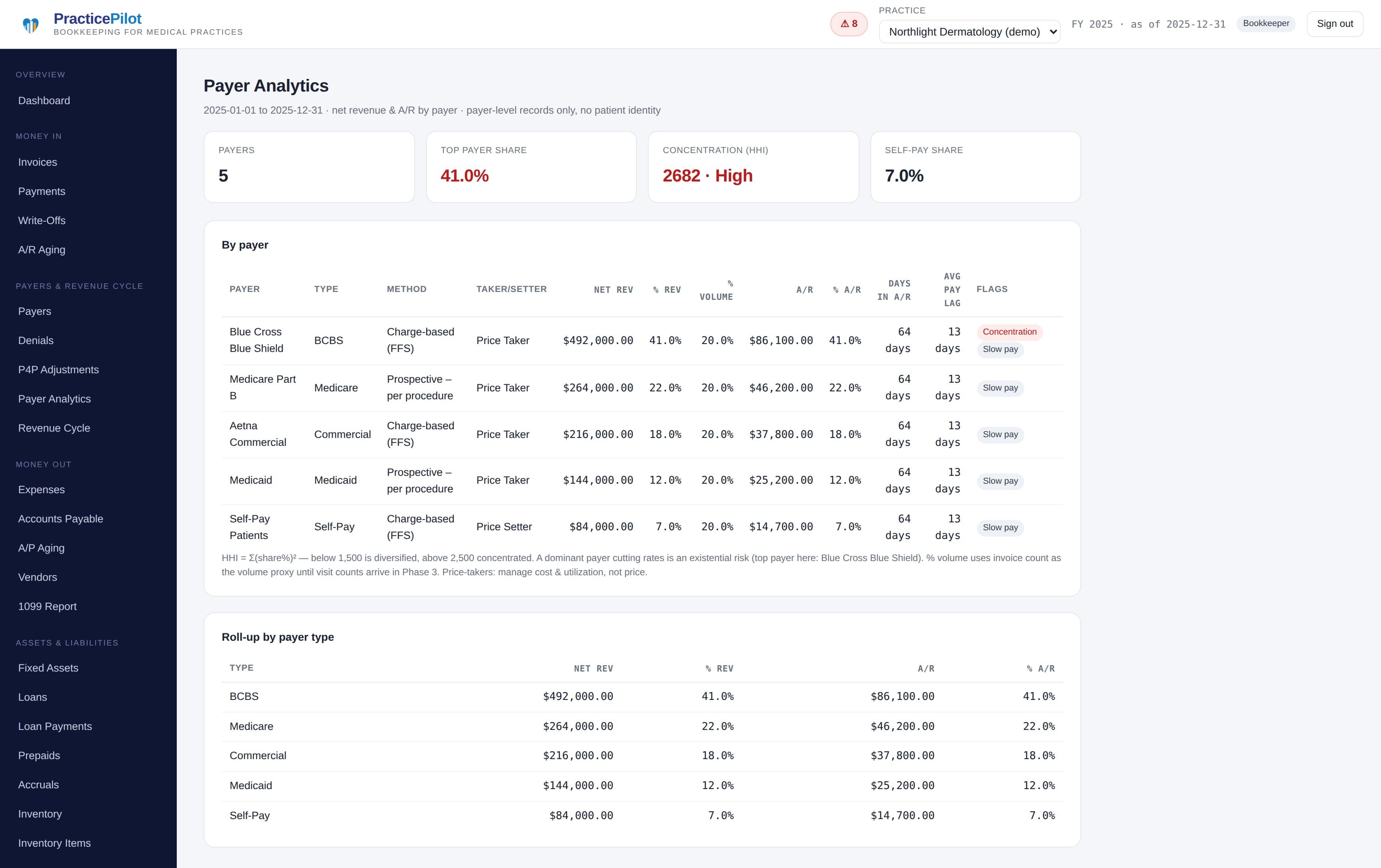
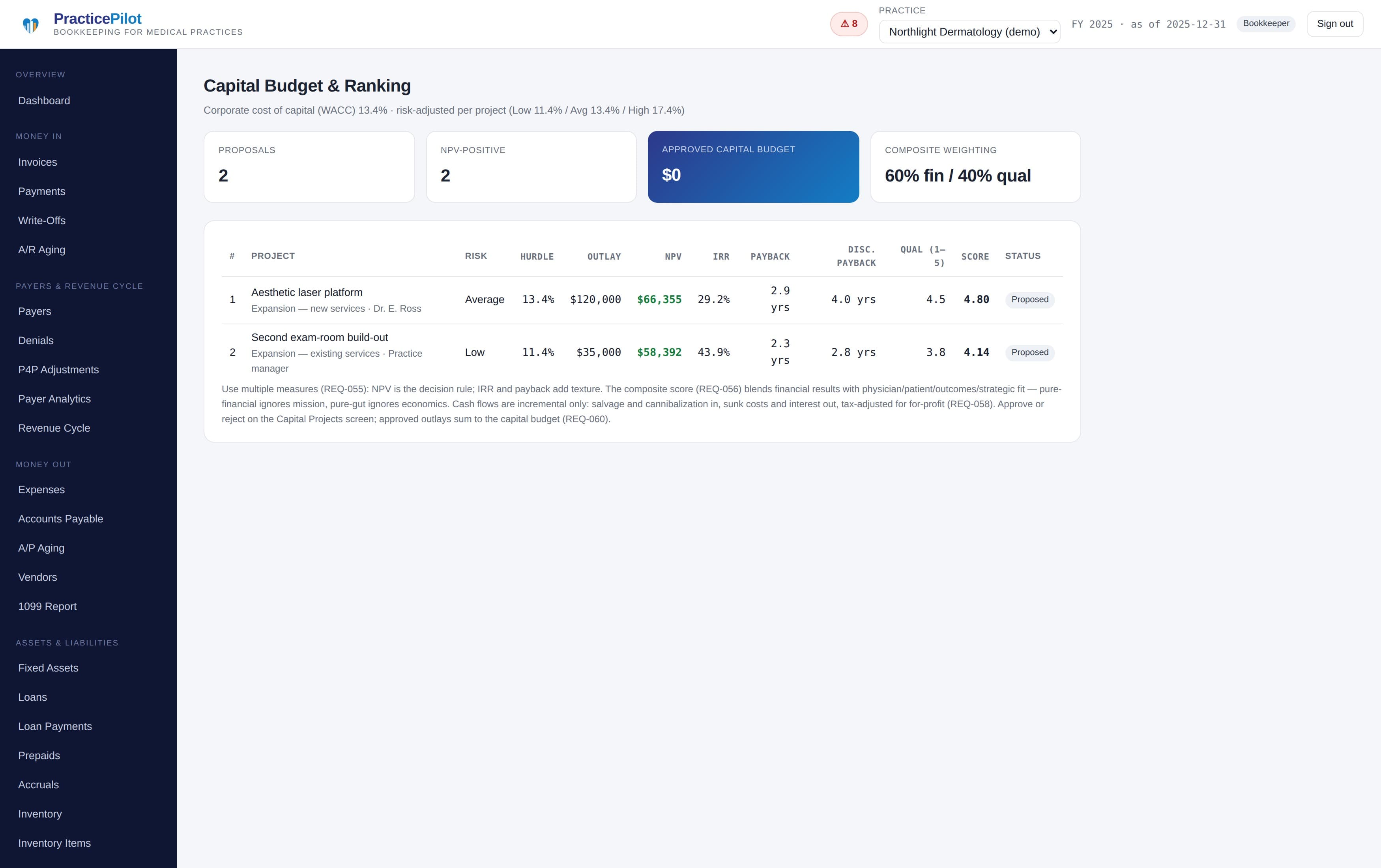
The real product on real books: payer concentration, receivables aging past ninety days, a payer that loses money on every visit, and the capital call priced against your true cost of capital. All PHI-free.
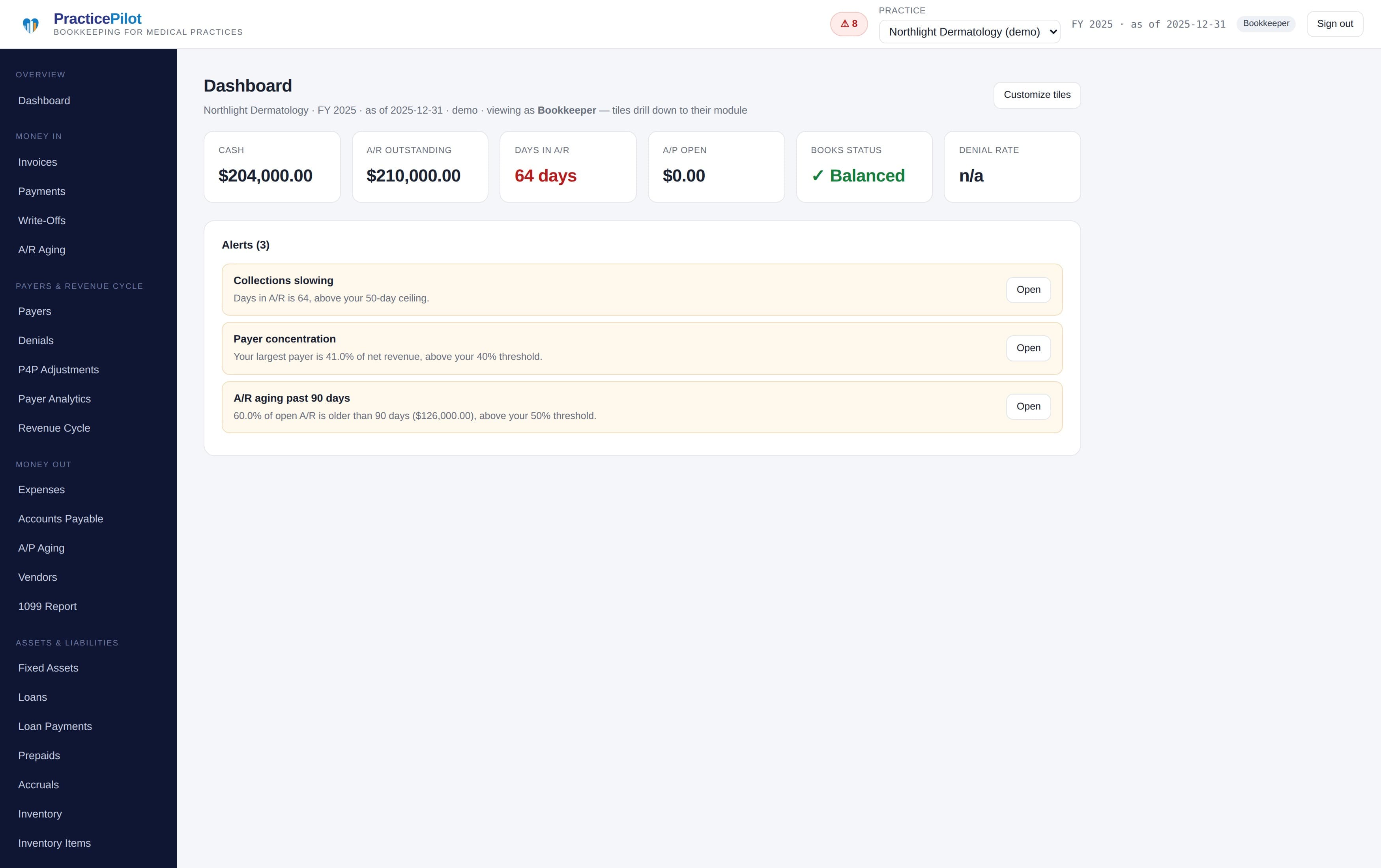
These numbers were hiding in books that balanced perfectly.
Our demo practice reconciles to the penny. It's also quietly bleeding. Balanced books tell you the money is counted, not that the money is safe.
Figures from PracticePilot's demo practice, sample books, real math. Your numbers will be your own; the point is that clean bookkeeping alone would have surfaced none of them.
Five ways a healthy-looking practice loses money.
None of these show up on a P&L. All of them show up eventually, usually late, usually expensive.
One payer owns you
When a single insurer is 40% of revenue, their next contract renewal is a negotiation about your survival, and they know it.
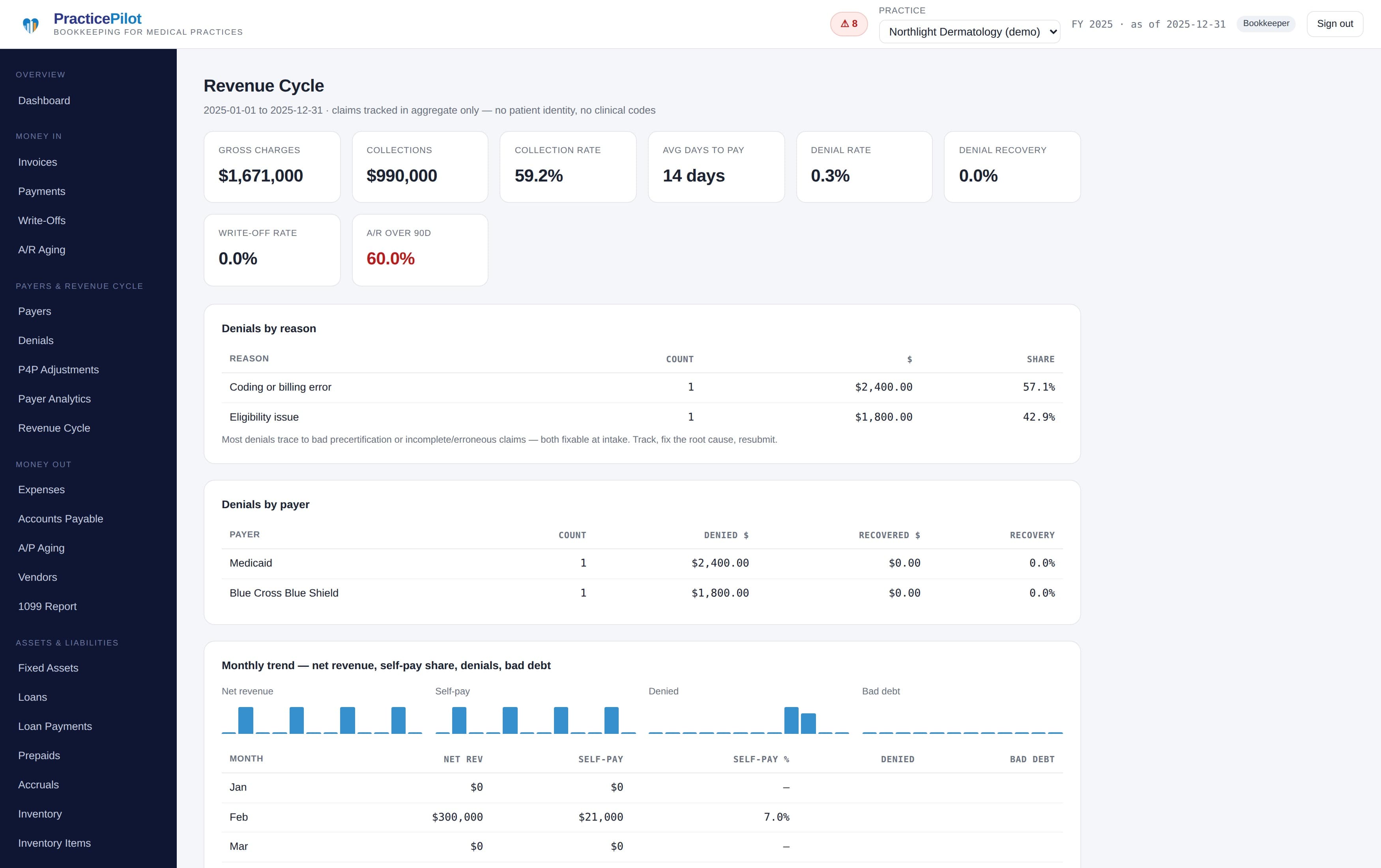
Denials quietly compound
Denied claims that nobody resubmits, and receivables aging past 90 days, are interest-free loans to insurance companies, made monthly, forgiven annually.
Averages hide the losers
A profitable practice can lose money on every visit from one payer, or on a whole service line, cross-subsidized by the winners so the total looks fine.
Profit isn't cash
The classic death spiral: the income statement says you're winning while receivables balloon and the account drains. By the time payroll bounces, it's history.
Six-figure gut feel
Equipment gets bought on a rep's brochure and a good quarter. Nobody prices the machine against the practice's real cost of capital, or checks the forecast after.
Your EHR knows your patients.
We only know your numbers.
What an invoice holds
Six decisions your books should be making better.
Every screen in PracticePilot exists to answer a question an owner actually asks, with the math a hospital CFO would use, sized for an independent practice.
Books that watch themselves.
You set the thresholds once. PracticePilot checks every one of them on every change, and tells you while the fix is still cheap.
Everything derives from one balanced ledger.
Real double-entry accounting underneath, so Assets = Liabilities + Equity always holds, and every analytic is computed from that same ledger. No side spreadsheets, no "adjusted" numbers, no drift.
The books
- Double-entry ledger, auto-posted
- Income statement, balance sheet, cash flow
- Trial balance & reconciliation checks
- A/R & A/P aging, 1099s
- Automatic depreciation & amortization
Revenue & payers
- Payer master: mix, HHI, pay lag
- Denials by reason & payer, spike alerts
- Write-offs, bad debt vs charity
- Net patient revenue taxonomy
- Collections-focused A/R views
Costs & pricing
- Cost centers & overhead allocation
- Cost per visit & per service (RVU/CCR)
- Break-even & CVP solver
- Contract & capitation analyzers
- Provider scorecards
Plan & control
- Budgets with approval workflow
- Flexible-budget variance decomposition
- Seasonal forecasts with assumptions
- Owner-set alert thresholds
Capital & debt
- NPV / IRR / payback vs your WACC
- Project ranking & postaudit
- Debt schedules & covenant alerts
- After-tax income & tax depreciation
Insights
- Benchmarks & multi-year trends
- Strengths / weaknesses, with caveats
- Configurable role-aware dashboards
- Four-Cs coverage map
Onboarded in a week. Sharper every month after.
Hand us the books
One onboarding conversation: opening balances, payers, services, vendors. We never ask for a patient record, there isn't a field for one.
We run them on PracticePilot
Your specialist keeps the ledger, every entry balanced, period-end adjustments automatic, reconciliation continuous, alerts triaged before they reach you.
You get decisions, not statements
A monthly close that arrives pre-read: what moved, why, and what deserves a decision, renegotiate this payer, reprice that service, buy (or don't buy) the machine.
Your finance department. One flat rate.
A fractional CFO runs $3,000 to $10,000 a month, if they'll take a practice your size. A bookkeeper alone hands you statements, not decisions. PracticePilot is both: books kept by a specialist, decisions delivered with them.
- Monthly bookkeeping, close & reconciliation, done for you
- All statements, A/R & A/P aging, 1099s, year-end CPA-ready package
- Payer intelligence, revenue cycle, costing & budget tools, configured and maintained
- Owner dashboard with alerts, triaged by your specialist
- Monthly financial review call
- Everything in Practice CFO
- Weekly 1:1 working session on your numbers
- Payer-contract & service-pricing analysis on demand
- Annual budget built with you; monthly variance narrative
- Equipment & expansion modeling (NPV vs your cost of capital), draw planning
- Priority access to your specialist
- Everything in CFO Advisory
- Separate books per location, consolidated view
- Location-level dashboards & margin comparisons
- Dedicated review cadence
Founding rates, plus a one-time $1,500 onboarding fee that covers setup, catch-up review, and migration of your existing books. We onboard a limited number of practices each quarter so every ledger gets a specialist's attention. PracticePilot provides bookkeeping and financial-analytics services, not tax, audit or CPA services, and never medical advice.
The things practices ask us first.
Do you ever see patient information?
How is this different from QuickBooks or a bookkeeping service?
Who actually does the books?
I already have a bookkeeper. What happens to them?
I'm a physician, not a CFO. Will I understand it?
What if my billing is unusual, capitation, locums, equipment-heavy?
Can I get my data out?
Run the practice like it's your life's work.
Because it is. Fifteen minutes with your own numbers will tell you more than this page ever could.